Solving Heat and Fume Problems with Solar Whiz
Solar Whiz’s Commercial Warehouse Ventilation & Industrial Ventilation is the new benchmark for heat extraction!
Tackle heat extraction, fume removal and air quality management in industrial and commercial facilities with Solar Whiz!
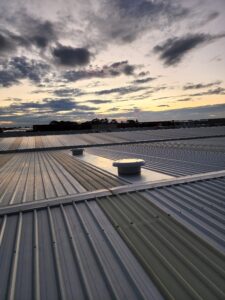
When heat gathers in your commercial or industrial property, it quickly becomes uncomfortable. Large-scale properties such as warehouses particularly feel the immense heat in summer, as insulation can be expensive, and difficult to install on such a scale. It’s well-documented that poor air quality or uncomfortable heat reduces productivity, and can even pose a risk to stock in warehouses. Even worse, it can even cause heat illness if employees are exposed to high heat levels for too long.
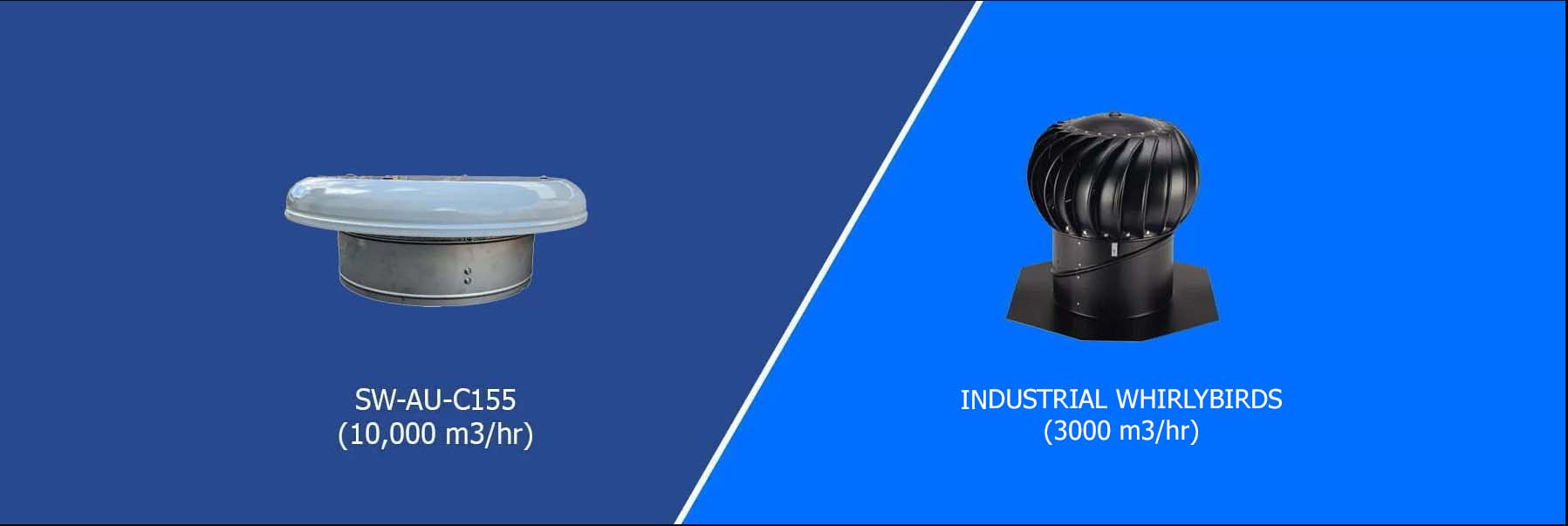
Conventional roof whirlybirds only move around 100 m³/h (cubic metres of air per hour). To effectively ventilate a warehouse so that the interior temperature is near to the ambient temperature outside, you would need an absurd amount of whirlybirds. In terms of industrial ventilation, this isn’t an effective solution.
Solar-Powered Ventilation – Taking Industrial Ventilation to New Heights!
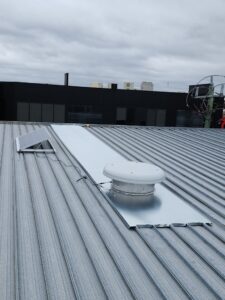
Solar Whiz’s Commercial range is some of the most powerful industrial extractor fans in the Australian market. Australian designed and made, especially for the Australian climate. We keep the worst excesses of Australian weather in mind when designing and manufacturing our industrial extractor fans. That means that you can be sure they are durable, tough, and capable of ventilating up to 10,000 m³/h with our largest industrial extractor fan model.
The Solar Whiz is designed with a sturdy fan cover that resists hail, and heavy rain. No matter the weather, you can be sure that Solar Whiz’ industrial ventilation system will keep you and your business well-ventilated and comfortable. Don’t settle for a lesser alternative—invest in the future of industrial ventilation.
Interested in finding out more? Shoot us a request for a commercial ventilation brochure!
“Our workshop is roughly 11,000 cubic metres and has recently had eight SW-RAF10000 units installed primarily to improve the air quality in our 32 vehicle bays. Since installation, our technicians have all reported a significant improvement in airflow and a reduction in workshop fumes. As we are in the tropics, even in winter the units run at full capacity for around 9 hours a day and during this period a slight breeze can be felt throughout the shop. We are waiting the return of summer in order to measure the anticipated reduction in temperatures within the workshop.”
An Effective Industrial Ventilation Solution for Warehouses with Heat and Fume Issues
Solar Whiz Industrial extractor fans come in two distinct sizes:
| Model | SW-AU-C-155 |
| Capacity | 10,000 m³/h |
| Fan Motor | 10-24 Volt DC Brushless motor with double shielded ball bearings |
| Fan Decibels | <73 dBA |
The SW-AU-C-155 is easily able to extract 10000 m³/h of air with a single unit. Depending on the type of commercial property you have, you may only need a few Solar Whiz units to adequately ventilate your roof space!
Airflow capacity
Commercial Warehouse Ventilation
If you have a warehouse, in many cases it may be vital to keep the entire warehouse space well-ventilated. Many products can be damaged by excessive heat, which makes warehouse storage in hot climates especially difficult. Investing in industrial air-conditioning units will keep the space cooled, but will be absurdly expensive to run. Purchasing conventional rotary-style industrial whirlybirds can also help, though results show that these old designs are incapable of moving enough air on their own. On top of that, you would need to purchase many whirlybirds to adequately ventilate an entire warehouse.
Solar Whiz Commercial gives you powerful solar ventilation. They operate purely with the power of the sun and can be wired to run overnight via a night operations kit. Conventional wind-driven turbines rely on the expansion of air to work—such as air being heated. Why let the air inside your warehouse warm up in the first place? Commercial warehouse ventilation is no struggle for Solar Whiz!
Extracting Heat, Humidity, Odours and Fumes with Solar Whiz
We’ve had customers install Solar Whiz industrial ventilators to exhaust and extract dust and fumes from their properties. The raw power of a Commercial Solar Whiz is able to keep toxic or unwanted fumes out of the industrial workspace, such as factories or chemical storage. Even commercial kitchens can benefit from Solar Whiz. Extracting oil or fumes is no issue for the SW-AU-C-155’s powerful potential. Solar Whiz’s commercial exhaust fans have a variety of uses in the workplace, no matter your industry.
Commercial Solar Whiz solar powered fans have been used to extract noxious fumes from refuelling stations in order to prevent gas build-up. It has also been used to ventilate moisture and steam from swimming centres and spas, helping prevent algae or mould build-up.
Interested in finding out more about our commercial solar fans? Check out our Commercial FAQ!
Cutting Costs on your Energy Bills with Solar Whiz Commercial
The Department of Industry & Science backed the publishing of The 20 Step Guide to Cutting Energy Bills in Your Business in early 2015. Amongst the many cost-saving tips provided in the guide were a couple of points regarding roof ventilation:
“Many businesses have used whirlybirds over the years, but some companies are now replacing them with solar powered roof ventilators.”
“Solar-powered roof ventilators have proven to be very effective in removing heat from enclosed roof spaces. The small solar panel drives the fan motor, which gives it a significant performance boost over the whirlybirds.”
Benefits of Installing Solar Whiz for Industrial Ventilation
1. Energy-efficient: By harnessing solar energy, Solar Whiz systems can help lower energy costs and reduce the carbon footprint of an industrial space.
2. Customizable: Solar Whiz offers a range of ventilation products and can work with customers to provide customized solutions tailored to their specific needs.
3. Improved air quality: Proper ventilation can help improve the air quality of an industrial space, reducing the risk of health issues and creating a safer, more comfortable environment for employees.
4. Reduced moisture and humidity: Solar Whiz systems can help reduce moisture and humidity in industrial spaces, which can prevent condensation, protect equipment, and improve employee comfort.
5. Easy to install and maintain: Solar Whiz systems are designed to be easy to install and maintain, with a low-profile design that fits seamlessly into the existing infrastructure of an industrial space.
6. Long-lasting: All components are made in Stainless steel except for the fan cap and flashing, which are made from aluminium. Solar Whiz ventilation systems are built to last, with durable materials and a weather-resistant design that can withstand even the harshest industrial environments.
7. Cost-effective: Solar Whiz systems offer a cost-effective solution for industrial ventilation due to solar power source and minimal maintenance requirements.
8. Australian-made: Solar Whiz products are proudly made in Australia, ensuring high quality and reliability.
The Future of Industrial Ventilation
Solar ventilation has helped many residential homes become more environmentally friendly. So why not consider it for commercial businesses? A Solar Whiz can help your commercial air conditioning and cooling, while also keeping air quality clean & well-ventilated.
Below are a number of articles & informative readings. Let these help guide you to a better industrial ventilation alternative with Solar Whiz Commercial.
Commercial Fans Comparison Chart —Roof Ventilation Blog, 2017
Air Change Rates for typical Rooms and Buildings —Engineering Tool Box
Suggested Air Changes for Good Ventilation—Greenheck, 2002
Recommended air changes for typical environments—Ricambi Aria
Industrial Ventilation FAQs — Australia
Answers to the most common questions about industrial ventilation requirements, compliance and solutions for Australian warehouses, factories and workshops.
What is industrial ventilation and why does my facility need it?
Industrial ventilation is the controlled extraction of heat, fumes, dust, humidity and airborne contaminants from large-scale facilities like warehouses, factories and workshops. Beyond worker comfort, it’s a legal obligation under the Work Health and Safety Act 2011 — and it protects temperature-sensitive stock, machinery, and indoor air quality. Without it, productivity drops, sick leave rises, and you risk non-compliance penalties.
What are the Australian regulations for industrial and warehouse ventilation?
Three frameworks apply. The Work Health and Safety Act 2011 requires employers to provide adequate ventilation. The National Construction Code (Part F6) requires openable area of at least 5% of floor area for natural ventilation (2.5% for sparsely occupied storage). AS 1668.2:2024 sets minimum mechanical ventilation rates — typically 10 L/s per person of outdoor air, with higher rates for fume-generating processes.
How many air changes per hour (ACH) does a warehouse or factory need?
ACH varies by activity. Storage-only warehouses need 4–6 ACH, machine shops and general workshops need 6–12 ACH, and welding bays, spray booths or fume-generating areas often require 15–30 ACH. To calculate units required: multiply your building’s volume (m³) by target ACH, then divide by the extraction capacity of each ventilator. Higher ceilings and hotter climates push the rate up.
How do I deal with heat stratification in a high-bay warehouse?
In buildings with ceilings above 6 metres, hot air rises and stratifies at roof level — radiating heat back down all day and trapping workers in uncomfortable conditions. Roof-mounted extractors solve this directly by removing heat at its source. The higher the ceiling, the more critical roof extraction becomes, because passive ventilation alone can’t shift the volume of trapped hot air fast enough.
How do I get rid of welding fumes, dust or vehicle exhaust from my workshop?
Contaminant-generating processes need dedicated exhaust ventilation in addition to general airflow. The required extraction rate depends on the contaminant type and generation rate, calculated per AS 1668.2:2024. For workshops, factories and refuelling stations, high-capacity roof extractors pull fumes up and out before they reach the breathing zone. See our Welding Fume Extraction page for fume-specific solutions.
Can industrial ventilation protect heat-sensitive stock in my warehouse?
Yes — and it’s often the cheapest way. Excessive roof-cavity heat radiates down onto stored goods, damaging electronics, pharmaceuticals, food products and packaging materials. Active heat extraction keeps internal temperatures close to ambient outdoor temperatures, which is dramatically cooler than the 50°C+ that can build up under uninsulated metal roofs in an Australian summer.
Is it cheaper to ventilate or air-condition a large industrial space?
Ventilation, by an enormous margin. Air-conditioning a warehouse or factory requires significant capital outlay plus ongoing mains electricity, often running into tens of thousands of dollars per year for large facilities. Roof ventilation removes the underlying heat-load problem rather than fighting it — and when paired with solar power, daytime running costs drop to effectively zero. For most industrial spaces, ventilation alone is enough.
Can I retrofit industrial ventilation to an existing warehouse or factory?
Yes. Solar Whiz industrial extractors are designed for retrofit installation on existing commercial and industrial roofs — corrugated metal, Colorbond, and most standard profiles. Installation typically takes hours rather than days, doesn’t require disrupting operations inside the facility, and doesn’t involve electrical wiring for standard solar-only configurations. Most installations can be completed without shutting your business down.